Sunday, April 2, 2017

To Prune or Not to Prune - Azaleas


Timing is everything to ensure a colorful spring.


With the weather becoming more pleasant you might be eager to do some pruning on your shrubbery.  Pruning some plants at the wrong time can prevent them from blooming.  Spring flowering shrubs such as azaleas and camellias set their flower buds the previous summer. Do not prune these plants until after they bloom.  
Camellias are slow growing and need just a little pruning to improve air circulation.  Thin out interior branches and keep the lower branches off the ground.  Clean up old blooms from the ground and replace the mulch to prevent flower fungal diseases. 
Azaleas are one of the most popular plants in the south and yet so misunderstood.  They are often pruned at the wrong time of the year. It is the short nights of summer that triggers the plant to form buds for next spring’s flowers.  Drought in summer can adversely affect the quantity and quality of flowers too.  When you prune azaleas anytime from summer to spring you will be cutting off flower buds.  The best time to prune Azaleas is just after they finish blooming until the first week in June. Shape azalea bushes into mounds. The lower branches should extend beyond the top of the plant. This will allow sunlight to reach the lower limbs. Too often I see bushes given a flat top. They look like the Yorktown Aircraft Carrier.  But take a closer look and you will see the bottom limbs are dead due to lack of sunlight. Azaleas do not need to be pruned every year.  I recommend cutting them back to knee high every 3 years and let them grow naturally the other 2 years. Feed them some organic fertilizer and plenty of water after you prune them and mulch with pine straw. You will be rewarded with a fabulous display of color next spring.

 Spring is a good time to shop for azaleas at local garden centers. This is the best way to ensure you get the colors you want. Look for new cultivars that bloom more than once. There is a new series of azaleas called Encore because they will bloom again in the summer or fall.  ‘Autumn Royalty’ is one of my favorites. The purple flowers bloom in the spring and again from August through November.  ‘Autumn Royalty’s’ purple flowers will pop when planted with yellow flowers.  There are over 25 of these multi-season azaleas now on the market and one of them is sure to become your favorite too.
Keep in mind this general rule of thumb. Prune spring blooming plants after they bloom, prune summer bloomers before they bloom.


.  

Thursday, March 30, 2017

Building a Better Tomato


Blossom end rot is common problem in tomatoes, but it can be found in other vegetables like peppers, cucumbers and eggplants.  Developing fruit have a calcium deficiency in the tissue which appears as a soft dark spot on the end of the fruit.  The problem is easy to prevent, but hard to cure.  Calcium is not readily available in soil with a low pH and adding dolomite lime will raise the pH and add calcium. Removing crops from the garden can deplete the soil of calcium and other elements. Potting soil has little if any calcium.  Young plants can absorb calcium better than older plants, so it is best to add calcium at planting time. If your pH is good, you can add Gypsum to your soil instead of lime. Gypsum is a natural mineral form of Calcium sulfate.  I recommend, when planting vegetables in the garden, mix 2-3 tablespoons of gypsum in the planting hole.  For potted plants, add about ¼ cup of gypsum to 3-5 gallons of potting soil.  Keep in mind that Calcium and other minerals are moved through plants with water and drought stress will also cause blossom end rot.  #blossomendrot


Gypsum is like duct tape for gardeners – it can fix a number of problems in the garden cheaply.
Gypsum also adds essential mineral sulfur along with calcium to the soil. Adding Gypsum will not change the soil pH.
In heavy clay soils, adding gypsum will loosen the clay and improve drainage.
Gypsum will displace salt and will help heal problems caused by pet urine in lawns. Just sprinkle about 1 cup around the affected area and water it in.
In garden ponds, gypsum can help settle clay and dirt particles, making the water clearer.
Gypsum will displace salts and will save a landscape when seawater washes over during a storm. 

In case you were wondering, gypsum is used in construction to make plaster.  The ancient Egyptians used gypsum to cover the walls inside the pyramids.  However wasn’t till 1769 that a German scientist, Johann Friedrich Mayer, discovered that gypsum made a great fertilizer. #gypsum

Shrimp and Crab Meal are great sources of natural calcium too; they also have Nitrogen, phosphorus and other trace elements.  Crab (4-3-0) Shrimp (6-6-0)

Magnesium sulfate, commonly known as Epsom Salt, Add a table spoon of this at planting and again every spring.  Magnesium is important for chlorophyll production. Plant proteins are made with Sulfur. Epsom Salt Foliage spray 2 tablespoons per gallon or 1lb. per 1000 sq feet
I don’t think I can say enough about adding Mushroom Compost  to any garden soil  Getting compost in the ground before you plant will be more beneficial than trying to add some later. Also adding a truck load of compost will raise your bed and improve drainage

Friday, December 30, 2016

All that Glitters are not Goldfinches


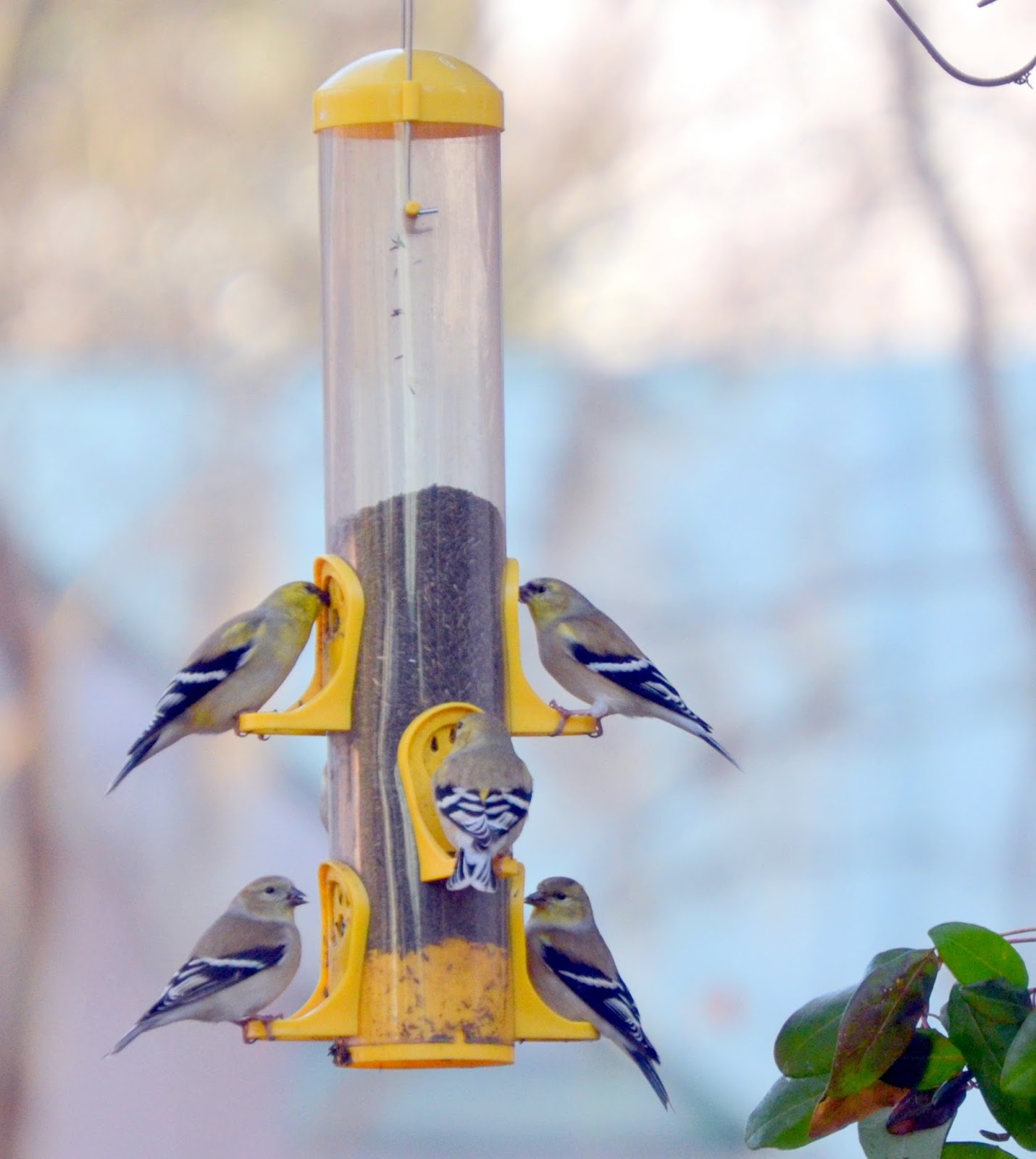
A friend of mine had a flock of small birds at her feeders that she could not identify. She had looked in books but the dull yellowish grey birds were a mystery. I asked her could they be Pine Warblers or Yellow-rumped Warblers and she said  “No they did not look like any of those birds.”  It dawned on me that she had a flock of Goldfinches at her feeders but the small bird field guide she had only showed birds in their summer plumage.  Many birds have such different seasonal plumages that they look like completely different birds.  It is important to purchase a bird field guide or smart phone app that has all a bird’s plumages. Some smart phone apps also come with bird songs and calls and this feature can help correctly identify some birds.  The flight call of the American Goldfinch sounds like they are chirping “potato chip, potato chip, potato chip”. While most birds fly in beautifully synchronized flocks, a goldfinch flock looks like chaos.  A goldfinches flight pattern looks they are on a roller coaster, as one bird swoops up another swoops down.  I have often wondered why they don’t collide.
Like other finches, the goldfinch has a short conical bill that is ideal for opening and consuming seeds.  At the feeder, they can quickly clean you out.  They prefer oil sunflower and nyjer seeds at the feeders and will eat on the feeders or on the ground.  In the wild, they seek out seeds of any member of the aster family with thistle and dandelion being some of their favorites. They also eat grass and other weed seeds. Unlike other song birds which consume some insects, the goldfinch has a pure vegetarian diet.
Goldfinches live in central Virginia year round. They change their plumage twice a year.  In late summer, they transform from sunny yellow to dull little birds.  In the late winter, they shed their dull winter feathers for bold summer colors.
Goldfinches are our smallest finch; they are about the size of a chickadee. They are often seen feeding with House finches in the winter.   Keep your feeders full this winter and when spring comes, maybe you will be able to see them change into their colorful summer feathers.


Thursday, June 16, 2016

Hydrangea - Flower of Many Colors

Hydrangeas are to summer what Azaleas are to spring: a dramatic punch of color in the landscape. In older neighborhoods, large shrubs of mophead Hydrangeas dominate the garden with billowing blue flowers signaling the start of summer. Blue is a rare color for flowers and will get plenty of attention; stealing the show from other flowers.  But not all Hydrangeas are blue. White, pink and purple mopheads can also be found along with Lacecaps, Oakleaf, Peegees and Arborescens.  Lacecaps and mopheads are closely related. Botancally they are Hydrangea macrophylla and native to Japan. The color of the flower depends on the pH of the soil. Most of the Hydrangeas around here are blue because the soil is slightly acid. Adding lime in the fall will turn the flowers pink the following summer. If you want to have fun with your hydrangeas, sprinkle a hand full of Lime on one side of the bush and a hand full of Aluminum Sulfate on the other side. When the Hydrangea blooms you will have pink, purple and blue flowers. This trick will not work with white mop heads but they will blush with pink hues as the flowers fade. Hydrangeas age gracefully turning mauve, slate and chartreuse and other antique shades providing weeks of changing colors.
 Hydrangeas are great cut flowers and are a favorite of June brides and Church Flower Guilds. Just cut a handful of blooms, remove the lower leaves, and stick them in a vase for an easy flower arrangement. 
If you are trying to grow more native plants then Oakleaf and Arborescens Hydrangeas are for you. Both were traditionally white but now a few pinks are on the market. Pinky Winky Oakleaf starts out white and turns pink as the flower ages. Oakleafs need really good drainage, plenty of sun and room to grow. They often get 12 feet tall. The orange fall leaf color is a bonus.
The cultivated Arborescens Hydrangeas have huge white mopheads and often need staking. The wild forms look more like Lacecaps with smaller flowers. ‘Annabell’ is one of the most popular cultivars but new pink cultivars have hit the market in recent years. Plant them in morning sun or dappled shade.
Pruning Hydrangeas can be a little tricky, but the old garden rule “Prune after the bloom” holds true for Hydrangea macrophylla both mopheads and lacecaps. Flower buds for next year form in the summer. Flower buds are easy to identify –big and fat compared to leaf buds. So when you prune, cut just above a fat bud.   But all hydrangeas can go for years without pruning. I only prune them when I cut them for flower arrangements. Peegee and Arborescen Hydrangeas bloom on new wood and can be pruned in the winter without loss of bloom. Peegees and Oakleafs can be trained up like a small tree.  

When purchasing Hydrangeas look for repeat bloomers and new color combinations to try in your garden.
#Hydrangea #flowers #gardens

Wednesday, March 16, 2016

The Tale of the Shamrock


 by Kathy Woolsey

Shamrock Shenanigans
The days of my youth were spent happily in the backyard playing croquet and looking for four leaf clovers. My cousin Joanne and I spent hours close to the ground among the white clover flowers seeking out the prized four leaf clover surrounded the many three leaf clovers.

We would make daisy chains out of the flowers for necklaces and headbands. The coveted  four leaf clovers were often pressed into Bibles and other books to show off for later. Our ability to find four leaf clovers impressed many other children and adults.  Back then ‘White Dutch’ clover was planted with grass seed to help improve the soil. Like all legumes, clover had nitrogen fixing bacteria in its roots therefore it could help feed the grass.  ‘Dutch Clover’, Trifolium repens only grows about 6 inches tall and makes a great cool season ground cover. Many types of native bees and honey bees sip nectar from the flowers of clover. I was shocked to learn that ‘White Dutch’ Clover is often considered a weed in lawns and people buy herbicides to kill it.  I don't like certain weeds in my lawn either, but I always avoid killing the Clover because even to this day I will stop and look for a few four-leaf clovers.

Myth Buster
But how did the Clover become a symbol for St. Patrick and Christian Ireland?
There are 2 thing most folks know about St. Patrick: He went to Ireland as a missionary and used the 3 leaf clover the teach about the Trinity and he drove the snakes out of Ireland.
Well let’s clear up this snake myth right away. There were no snakes in Ireland. Some islands like Iceland, New Zealand and Ireland have not had these reptiles since before the last ice age. Myth Busted!

As for the clover myth, there is a good possibility it may be true. Part of the problem is that St. Patrick lived a very, very long time ago, March 17 in 493 is generally believed to be the date of his death. There are only two documents believed to have been written by him These are the “Declaration”  and the “Letter to the soldiers of Coroticus”. In the “Declaration” he gives the story of his life. There is no mention of clovers, shamrocks or snakes in either document.

Shamrock comes from Irish seamróg, which means small clover. There are many members of the Clover or Trifolium family in Europe. Trifolium dubium, with yellow flowers and Trifolium repens, with white flowers are common plants in Ireland and would have been a handy visual aid for St.Patrick or any Christian missionary. The first time St.Patrick was depicted holding a shamrock was in 1675 on a coin call the St. Patrick's Copper.  On the coin St. Patrick is dressed as a bishop and holding a clover and preaching to a crowd. Was the clover put on the coin to symbolize the Trinity or Ireland?  

But is the clover of my childhood the real shamrock? Two recent surveys were conducted in Ireland asking people to identify the shamrock. More than half of the people call the yellow flowering Trifolium dubium  the shamrock, about 1/3 said the ‘White Dutch’ was the shamrock. Less than 10% identified Trifolium pratense red clover or Medicago lupulina Black Medick as Shamrocks. Oxalis acetosella the Wood Sorrel was identified by less than 3% as the shamrock. Oddly enough in America Oxalis is often sold at garden centers as “Shamrocks” even though most Irish would disagree.  Black Medick is a common lawn and roadside weed and more abundant in the south than ‘White Dutch’ or the common red clover.  Both ‘White Dutch’ and Black Medick bloom during the month of March.  


I think there was a good possibility that St. Patrick or other Christian Missionaries could have used a 3 leaf clover to explain the Trinity. So why are the 4 leaf clovers lucky?  Perhaps it is because they are rare, but to me they represent the Cross.

Monday, March 7, 2016

Strawberries the Edible Groundcover

We have strawberry plants in the early spring for sale 


It’s a native plant, healthy and delicious but did you know that strawberry plants make a great groundcover? If you are thinking about a sustainable landscape or an edible landscape, you might want to replace some of your lawn with strawberry plants.  Strawberry plants multiply quickly by sending out 6-8 runners that produce new plants the first year.
Strawberries need full sun but a little afternoon shade will be fine. The next consideration is the soil. While they can be grown in most garden soils, strawberries prefer a sandy loam that is deep and contains very high amounts of organic matter. Extra compost and peat can be added to your selected site to create the best environment for growing strawberries. After planting, the soil must not dry out completely nor can it be water logged.  Strawberry plants prefer the soil moisture to be just right.
Planting the right cultivar for your needs
There are 3 different types of Strawberries, Day-neutral, Short-day (June bearer) and Everbearing strawberry varieties.
Day-neutral strawberry plants produce flowers buds no matter the day length, beginning three months after planting.  They will keep producing flowers and fruit if temperatures do not become too high.  Cultivars to look for are Tribute, Tristar,Seascape and Evie2.
Formally known as June bearing, Short-day strawberry plants begin flowering when the day length is 14 hours or less or when temperatures are less than 60oF. These plants are used when you want a big crop all at once like when you are making jam. Cultivars to try are Allstar, Chandler, Earliglow, and Sparkle.
Everbearing strawberry varieties aren’t really “everbearing.” They generally produce two harvests per year: one in the spring and another in the late summer or fall. Under ideal conditions, it is possible for some everbearing strawberry varieties to produce three berry harvests. Quinault is a very productive cultivar but Ozark Beauty is probably the best everbearing strawberry variety for the south. Mother plants produce runners and fruit well, but runner plants usually will not produce any strawberries during their first year but Quinalt will make berries on the runners the first year.
Strawberries have lovely little 5 petal white flowers but some cultivars have pink flowers. Pink Panda has bright pink flowers and does well in the south. The Day-neutral cultivars will have fruit and flowers at the same time making them both ornamental and edible at the same time.

For more information about strawberries check out the website www.strawberryplants.org.

Kathy Woolsey

Tuesday, February 2, 2016

About Us

Since 1900 Farmers Seed & Supply Co. Inc. has been the destination for farmers and gardeners in the central Virginia area.  We have been located at 1306 Main Street in Lynchburg, Virginia for over 100 years, selling garden seed, bulbs, vegetable plants, fertilizer,  potting soil, pesticides, hardware, tools, animal and bird feed, greenhouse supplies, lawn seed ,  and  thousands of other garden-related products.
We package and sell our own money saving no-frills label garden seeds and carry a complete line of Burpee, Weeks, Crossman, and Cooks Garden packaged seed.   We have Heirloom and Organic seeds including vegetable, ornamental and flower seeds.  We carry hybrid seeds but not GMO seeds. We stock organic fertilizers and pesticides that are  OMRI listed.
We are located just 2 blocks off Business 29 exit 1 (head north), or just one block from the Lynchburg Community Market.   

Keep up with our ever changing inventory on Facebook https://www.facebook.com/Farmersseed/

Thursday, December 10, 2015

Know Your Beans


Kathy Woolsey

   Is Green Bean Casserole on the menu this Thanksgiving at your house? My family serves green beans with a little pork for Thanksgiving and for just about every holiday.  I doubt green bean casserole was on the first Thanksgiving menu; French fried onions were hard to come by back then.  November would have been too late in the season for green beans anyway, but shelled beans were most likely served.  The Wampanoag’s grew many cultivars of Phaseolus vulgaris the common bean and shared them with the Pilgrims.  Kidney, Pinto, Navy, Black Turtle, and green beans are just a few of the hundreds of varieties of grown by Native Americans.   Today, the Seed Savers Exchange lists over 4000 cultivars of Phaseolus vulgaris from around the Americas.

     Common Beans can be bush, half-runner, or pole.  They can be eaten young as green beans or fresh shelled or dried.  These beans originated in Central America and quickly spread north and south. The Spanish took them east and west.   Eastern Native Peoples planted corn and beans together on the same mound so the beans could climb the corn stalks.

There are other species of beans native to the Americas, Phaseolus coccineus the Scarlet Runner bean, Phaseolus lunatus the Lima bean and Phaseolus acutifolius, the Tepary bean.

The Tepary bean thrives in the dry Southwestern US. They are rarely grown or seen around here. They are usually eaten fresh shelled or dried very much like the common bean.
The Scarlet Runner bean prefers a cooler climate. It is grown as an ornamental in many gardens for its bright red flowers. The beans can be black or purple. It can be eaten as a green bean and a shelled bean. I have never had much luck growing them around here. 

There has always been a debate about Lima Beans and Butterbeans. The truth is they are both Phaseolus lunatus. Some folks call the big ones Limas and the small ones Butterbeans. They are called Limas because Europeans first saw them in Lima Peru.  ‘Carolina Sieva Pole’ bean is an heirloom variety that thrives in the heat and produces small white butterbeans. ‘Thorogreen’ Bush Lima is the most popular variety in the South, with a good yield of light green colored beans that are wonderful in Okra soup.    


At Farmers Seed we sell about 20 different varieties of green beans Phaseolus vulgaris.  Our favorite is ‘Roma II’, a flat pod with a white bean. The pods are flavorful and always tender and never a string even when the pods were mature. We called them snaps. Every Sunday mother would fill the bottom of a big pressure cooker with snaps and a piece of side meat and place peeled white potatoes on top. This she would cook until the potatoes were soft and the snaps would melt in your mouth.  #beans, #Garden

Tuesday, December 1, 2015

The Three Sister Garden of the First Peoples


Although we grow many of the same crops as Native Americans, our gardens look very different.  Today we plant our gardens in neat rows that are carefully spaced and our crops organized for crop rotation.  A patch of corn here and a few rows of beans over there and then there are large commercial farms with hundreds of acres of a single crop. Native Americans developed a unique system of companion planting that was well established before Europeans arrived.  Corn, beans, and squash were gifts of the Great Sprit and were called the Three Sisters and always planted together in the garden.  The Three Sisters Garden has always fascinated me for I am the oldest of 3 sisters and we all love to garden.
There were many tribes in North America and many had their own legends about the Three Sisters and there were variation in the garden design as well.  Some gardens were large circles with mounds of soil spaced 4- 5 foot apart.  The mounds were about hand high and 20 inches wide, with a flat top.  The corn was planted first.  Many of the First Peoples looked for a sign from nature to tell them it was time to plant. My father always said to plant corn when you hear the Whip-poor-wills calling at night.  
Planting the Sisters
Men hunted, fished and tended the tobacco plants. Women cleared the land and did most of the vegetable planting.  Four corn seeds were planted on the top of the mound in a circle spaced about a hand stretch apart. Often the seeds were lined up with the compass points to honor the four directions.  When the corn reached about hand high, the beans were planted in between the corn to complete the circle. After the beans were up the squash was planted on the side of the mound.  The three sisters helped each other as sisters do. The beans could climb up the corn and provide the corn plant Nitrogen in the soil. The squash would run about on the ground and shade the soil keeping moister in and weeds out.  There were some variations; sometimes the squash was planted on smaller mounds in between the larger corn and bean mounds.  The First Peoples cook corn and beans together in a dish called succotash.  The Proteins from the corn and bean combination is equal that of meat. 
Some eastern tribes planted Sunflowers Helianthus annuus along the north edge of the garden. Tribes west of the Mississippi planted Cleome hassieranna around the garden.  Lewis and Clark called the cleome the Rocky Mountain bee plant.  These flowers provided food for the pollinators and the sunflower seeds provided food for the people too. 

 Pumpkins are the unruly sister and were planted in a separate patch because the vines could climb up the corn and the heavy weight of the fruit would pull down the corn.   Did the Pilgrims serve pumpkin pie at the first Thanksgiving? Probably not, since sugar, flour and Crisco were in short supply in 1621. Traditionally a whole pumpkin was placed on a bed of hot embers and roasted until it collapsed and then served without any Cool Whip. 
Kathy Rice Woolsey 

Tuesday, April 14, 2015

Butternut Squash -Very Good


“Try it, it’s good for you” was a common phrase at our table, usually said by me and directed to my boys. However with Butternut squash I would say “this is really, really good for you”. 
Butternut is a super food packed with vitamins, fiber and anti-oxidants and I think it tastes good too. Last Thanksgiving, I used Butternut instead of pumpkin and nobody noticed my pumpkin pie had no pumpkin in it. 
Why is Butternut a super food? Cooked Butternut has an incredible 457% DV Vitamin A and 51% Vitamin C to start with.  Compare that to Acorn Squash at 12% vitamin A and 25% vitamin C. Oranges have 85% Vitamin C but only 4% Vitamin A. Plant based Vitamin A is called Beta carotene and is an important anti-oxidant.  Vitamin A helps protect the surface of the eye and is important for good vision. Vitamin A deficiency in children can lead to blindness.  Other orange vegetables such as Cantaloupes and Sweet potatoes are also high in Vitamin A.
An added bonus with Butternut is that it is easy to grow and versatile in the kitchen. I grew Butternut and Spaghetti squash last summer and was surprised how well they grew. Butternuts needs full sun and plenty of room. The vines can run 15 feet or more.  It is important not to pick the squash too soon.  If you want to store it during the winter, let the stem turn brown or die before harvesting. Be sure to cut off the stem about 2 inches long – if the stem is removed the squash will not store long.  I leave the butternuts and spaghetti squash on the porch a few weeks to cure. Then I bring them in the house where they will sit in the kitchen for months until I need them.  Butternuts can be made into pies and soups or roasted or pureed.
My friend Sherri has traveled several times to Australia and she says that Butternut is on almost every menu.  This American vegetable is called Butternut pumpkin in the land down under where it is used as a vegetable and dessert. 
Many recipes call for you to peel before you cook it but I think it easier to cook the butternut first and simply scoop out the meat.  To prepare butternut, I cut the neck off and cut again lengthwise and remove the seeds. I prefer to steam it in my presser cooker but it can be microwaved and baked in the oven as well.  After it is cooked, it can be used to make a pie or you might want to try this soup recipe given to me by Sherri Edwards.  This is my favorite way to eat Butternut Squash if you do not like spicy soup leave out the pepper jack cheese. A perfect soup for a cold winter day and it’s good for you too.
  Butternut and Cheddar Cheese Soup
I large Butternut cooked
4 cups broth (chicken or vegetable)
1 cup sour cream or yogurt
½ c. mild cheddar cheese
½ c. pepper jack cheese
¼ teaspoon ground red pepper and salt and pepper
Add the cooked squash to the broth and puree with a hand blender or blender.  Heat on the stove top slowly and add the sour cream. Do not let the soup come to a boil or the cheese will separate. Add the cheese and spices. Serve as soon as the cheese melts.  I like to garnish with a sprinkle of red pepper flakes.


Wednesday, April 2, 2014

Spring -Time to Plant the Summer Bulbs

.
Bulbs are pretty amazing things. They have the ability to survive harsh environments and then when conditions are right they awaken and grow.   Summer flowering bulbs have been sitting in a warehouse all winter and are now in stores ready to plant.  Care must be taken to select live healthy bulbs.  You have experience in doing this because the most popular bulb in the world can be found in the supermarket- the onion.  Avoid bulbs with cuts, bruises and soft spots and beware of bulbs that may be too dried out.  I like to shop for bulbs at places that let you rummage through a box of loose bulbs and pick the ones you like.
Ok, now for the technical stuff: I have been using the term bulb rather loosely. The botanical term is geophyte which includes corms, rhizomes and tubers.  I like the word geophyte. It literally means earth plant.  It is easy to spell and pronounce, which is rare in the field of botany.  Now back to the fun stuff !
The only problem around here for bulbs is poor drainage during the dormant season.  Long periods of wet soil can lead to bulb rot.  Also underground voles will eat some geophytes.  If you do not have a cat you might want to try a product called PermaTill.  This stuff looks like kitty litter but is kilned slate. The particles have a rough surface which voles and moles hate to dig in.  Mix a generous amount in your flower beds and it will improve drainage and aeration too.
Here is my short list of bulbs to try around here.
Calla Lilies Zantedeschia are native to the marshy areas of South Africa and are related to Elephant Ears (Alocasia). They need full sun and rich moist soil in the garden. Plant the bulbs so the top of the bulb is about one inch below ground with added compost.  Feed them every 2 weeks with 20-20-20 liquid fertilizer. Stop feeding the first of August. The White Callas are the most fragrant.  Pink and purple callas do better in part shade. Callas make good potted plants and some callas have interesting spotted foliage.
Pink Rain Lilies or Pink Fairy Lilies. Habranthus robustus is a relative of our native Zaphyranthes atamasco. These dainty flowers are native of Brazil and are happy on our island. They often pop up and bloom after the first summer thunder storm. The light green foliage comes up in the spring before the flowers bloom. Rain Lilies are easy to propagate from seeds and dividing clusters of bulbs. Collect seed pods when they turn yellow and then scatter seeds where you want them. They can be planted with other small bulbs like daffodils ‘Tete a Tete”, or ‘February Gold’. Try other rain lilies too.  The white rain lily Zypheranthes candida, and the  yellow rain lily Zypheranthes citrine do well  with little care.
Gladiolus are the workhorse of the florist industry and what funeral would be complete without them. These South African iris cousins come in a rich selection of colors and shades from purples, reds, yellows pinks and whites and many are bicolored. They also come in a good selection of sizes too. I like the dwarfs or nanus because they do not need staking. For the giant glads, I recommend planting them deep, in a circle and use a tomato cages for support. If you are using them for cut flowers, don’t plant them all at once. I have planted them as late as August for October blooms.
Dutch Irises are also a favorite of flower arrangers. They are one of the few bulbs that can be planted in the fall and spring. They do not store well or take the summer heat, so plant them as soon as you get them. The foliage will die in the summer heat but return in the fall.
Lillies are a big group with several different types. They have done very well for me here and I don’t know why they are not more popular. Longiflorums are the Easter lily types. They come in white and pink. You can plant those leftover potted Easter lilies in your garden. Just cut off the dead blooms and they will bloom next year but rarely on Easter. The Asiatic Hybrids are smaller, hold up better in the garden and make great cut flowers.  I recommend starting with these. Flower colors include yellows, whites, pinks and bi-colors. The Oriental Hybrids have very big flowers and will need some staking. Colors are whites, pinks and bi-color. They often have spotted petals.  The Trumpets are tall with large flowers and a good selection of colors.  They will need support. To add to the confusion, hybridizers have crossed all of the above lilies with some interesting results including striking color patterns. If you like natives there are a number of species and wild forms available too.  Although it is recommended that lilies get full sun, I have had good results in filtered sunlight. 
My secret to planting bulbs is a power tool. I use an 18 volt rechargeable drill with a 2 3/4 inch bulb auger. None of this getting on my hands and knees with a hand trowel for me.  I can plant about 50 bulbs in about 15 minutes. First, I drill all the holes, then toss in some fertilizer and PermaTill, drop the bulbs in the hole and kick the soil over the holes with my foot.  If I need a bigger hole, I just wiggle the drill back and forth.  I also use the drill to plant annuals and vegetables.
There are plenty of other geophytes that are worth trying, and if you are looking for something new then check out the International Bulb Society website at http://www.bulbsociety.org/


Sunday, March 23, 2014

Sowing Seeds and Saving


Adding plants to your garden does not have to be expensive.  Planting seeds is the most economical way to add flowers and vegetables to your garden.   There are two methods – direct sowing in the ground and starting seeds indoors. 
The advantage to starting inside is getting a little head start on spring. This can be a little tricky if you do not have a greenhouse.  The air in most houses is too dry for successful seed germination. Covering seed trays with a plastic cover or mini greenhouse will help, but this creates a second problem--poor air circulation. In commercial greenhouses, there are always fans running. Air movement prevents fungal diseases, so turn on your ceiling fan. Be sure to take off the plastic cover after the seeds have sprouted.
     If the weather is nice, one of the best places to start seeds is on a porch. The roof will keep the rain from washing away your seeds.  There will be plenty of fresh air and sunlight but bring the seed trays in at night to keep them warm.   Use a professional potting mix for seed starting. This should contain plenty of sphagnum peat moss and a little vermiculite.  One mistake beginner gardeners often make is planting seeds to deep.  Most seeds barely need covering, check the directions on the seed package. Some seeds require no covering of soil.  I like to use a plastic sand sifter (sold as a beach toy) to cover seeds with a light dusting of soil.
    Small seeds are best started indoors and larger seeds can be safely started in the ground.  Petunias, impatients, vinca, portulaca, salvia, alyssum and celosia are some flowers that can be started indoors.  Small seeded vegetables like peppers, tomatoes and basil should also be started indoors. 
When the soil has warmed up, seeds can be started directly in the garden.  Flowers with large seeds like marigolds, sunflowers and zinnias can easily be planted directly in the soil. Zinnias are surprisingly easy. If the soil is warm, they will germinate in 3 days. Large seeded vegetables and herbs like cucumbers, squash, dill and parsley can be sown directly outside.  The old rule of thumb is to plant a seed no deeper than the width of the seed. 
    When buying vegetable seeds select for disease resistance. ‘Big Beef’ is one of the most disease resistant tomatoes on the market.  ‘Spacemaster’ cucumber is great choice for small gardens or large containers.  Almost all types of peppers do well on James Island. My picks for flowers are any of the small types of sunflowers. Giant sunflowers typically produce only one flower and the cardinals love the seeds. ‘Lady in Red’ Salvia is an easy to grow flowers that will draw hummingbirds and butterflies to your garden.  
    Perennials and wildflowers do better is started in the fall. Buy the seeds now and store them in a plastic bag in the refrigerator.  If you wait till fall to buy them, they could be sold out. 

Part of the fun of gardening is trying something new and growing from seed is a great way to do just that.  

Friday, November 29, 2013

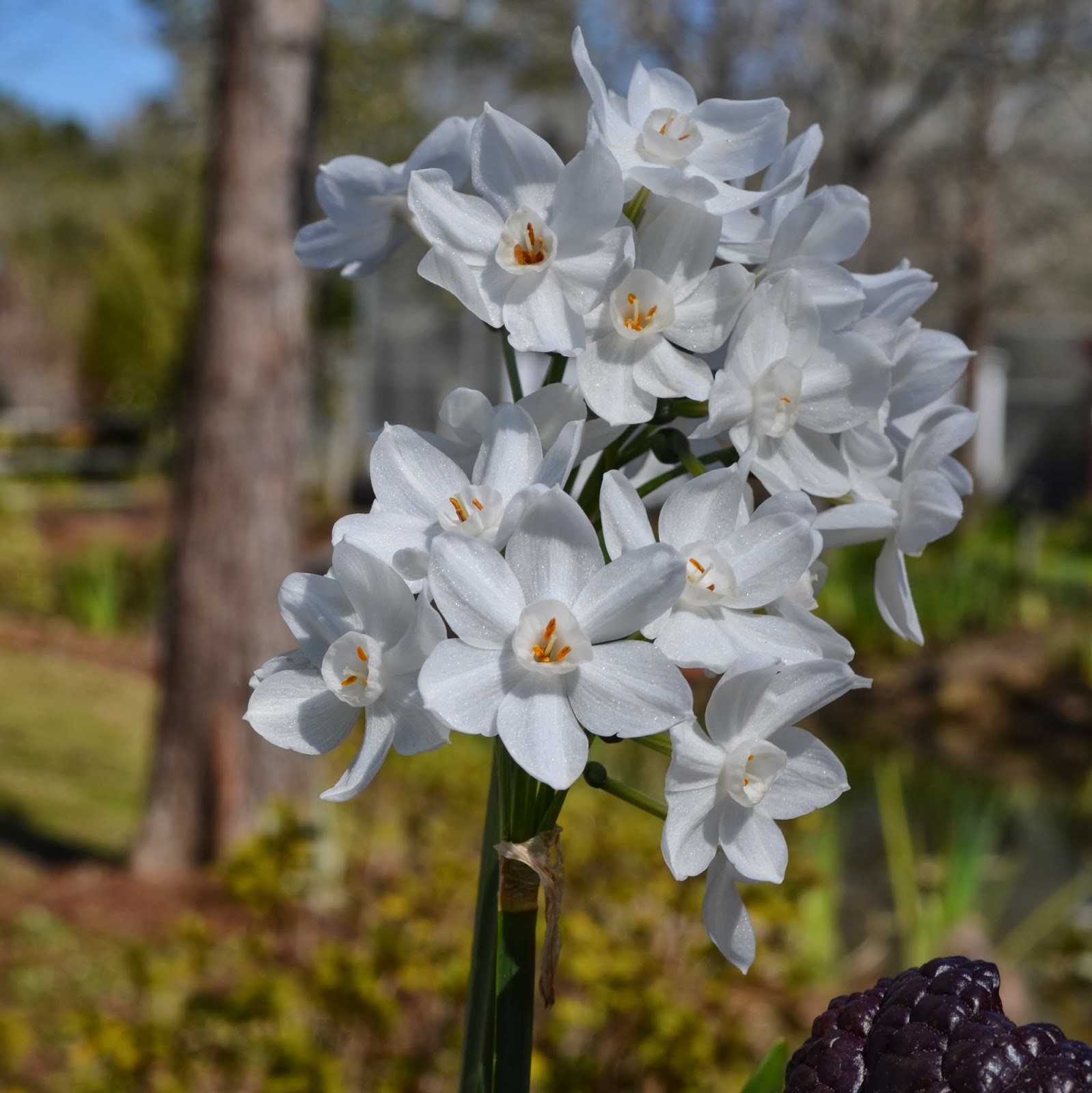
Paper Whites: A Christmas Tradition


I can remember my Poppy sending us to the store for “Paper White” Narcissus bulbs in November. We would plant them on Thanksgiving Day. When we returned to my grandparents’ house on Christmas day, the bulbs would be in full bloom.  In four weeks, the bulbs grew about 12 inches tall with small star-shaped flowers whose fragrance would fill the room.  
“Paper Whites” are Tazetta Daffodils and they are descendants of fall blooming daffodils from Spain. They are not very cold hardy and commercially they are grown in Israel.  Some popular cultivars are “Ziva,” ”Bethlehem,”   and “Nazareth.”  Also there is a double one call “Erlicheer” and a yellow cultivar called ”Grand Soleil d’Or’” and for those find the fragrance of the a little too strong there is “Inbal” that is almost fragrant free.

The bulbs can be planted in regular potting soil or in a dish with pebbles or glass beads. Just make sure the bottom of the bulb touches water. Keep them in a cool but sunny place until they bloom. To have bulbs blooming all winter, buy about 2 dozen bulbs and plant every few weeks. Store the bulbs in a cool, dry place until you are ready to plant. This fast growing bulb is a great flower to teach children about plants.  As a child, it seemed to me the “Paper White” was a real Christmas miracle.

Tuesday, May 14, 2013

Cicadas are Coming !!!

We have had folks coming in lately ask us how to kill the cicadas. We recommend leaving them alone. They do not sting or bit and the adults only live about 2 weeks, they sing, mate, lay eggs and die. That's it. The young feed deep in the ground on large tree roots. They may harm young newly planted trees, so hold off any tree planting till Fall. We started a Facebook Page for the 17 Year Brood 2 Cicada and invite you to add your stories and photos of this rare natural event. We hope you find it informative and entertaining.   https://www.facebook.com/17YearCicadas 

Friday, May 3, 2013

Potting Soil Sale


NOW on Sale- BACCTO ® Professional Planting Mix  1 cu. bag reg.$7.99 now $ 4.99. Until May 30, 2013, while supplies last.
BACCTO ® Professional Planting Mix is the same high-quality growing media used by commercial growers to ensure optimum growth potential. This special pre-moistened mix is blended in a special system that provides uniformity, easy handling, and the highest possible consistency. It's formulated to enhance the growth of bedding and potted crops in flats, pots, and hanging baskets where higher moisture reserves and shelf life are needed. With Professional Planting Mix, home gardeners can grow like the pros.

Sunday, April 14, 2013

Ready For Romaine


Did you know Romaine Lettuce is a very nutritional vegetable and can be compared to raw Spinach.  Romaine actually has more Vitamin A (82%) and C (19%) than Spinach and they both have about 15% Folate. But remember it’s the green part of the leaf that has the most Vitamins and Minerals.
Leaf lettuces are easy to grow from seed. They are a cool season crops and can be grown in early spring or fall. Ideal temperatures are between 45 and 80 degrees F. In the summer they can be grown in the shade of taller vegetables like tomatoes or peppers but hot weather can make them bitter.  Set out transplants about 1 month before the last frost of spring and 6 weeks before the first fall frost.  Don’t plant all your seeds at once, plant for 3 successive weeks and thin them as you harvest. Parris Island Cos was developed in South Carolina and names for the Famous Military Train Ground.  It is slow to bolt and hold up better in the heat.  Red Romaine is also available but colors up better in the cooler months. You should be able to start picking outer leaves in about 30 days or cut the whole head in 60-to 70 days. 

Sunday, April 7, 2013

Growing Tomatoes in Pots


One Tomato plant needs at least 5 gallons of soil- more is better.  There are Potting Mixes especially for tomatoes and other vegetable plants.  Try Pro-Mix Ultra Organic with Organic Garden-Tone Fertilizer.  Robin recommends ½ Shrimp Compost and ½ Pro-Mix Potting soil. The shrimp compost has calcium which is important, Calcium deficiency will cause Blossom End Rot in tomatoes.   Adding a handful of Gypsum (Calcium Sulfate) to plants in a pot or in the garden will prevent Blossom End Rot if you are not using shrimp compost.  It is also important not to let your soil dry out completely this will cause cracking in your tomato fruit, use a self-watering containers or pots with large saucers.   Bush type tomatoes and cucumbers are perfect for pots.  Try these Better Bush, Husky Red, Bush Early Girl, Patio, Bush Goliath and Bushmaster Cucumber.

Thursday, April 4, 2013

On Facebook

We finally started a Facebook Page and our goal is to post timely information about new shipments and garden product. Fresh garden plants, roots and bulbs come and go in our store so like us on Facebook to keep informed. We will use the blog for more detailed information. https://www.facebook.com/Farmersseed
 

Sunday, March 24, 2013

Kale Vegetable of the Year


Botanically speaking kale, cabbage, broccoli, collards and cauliflower are all Brassica oleracea . They are simply considered different cultivars. Kale is considered the most ancient form and maybe the closest thing to wild cabbage.  Brassica oleracea is from Europe and Kale was a staple for the ancient Greeks and Romans. Tasty, nutritious and easy to grow it spread quickly over the world.  Kale is a real superstar when it comes to nutrition. One cup of chopped raw Kale has over 200% DV of vitamin A, 130 % vitamin C, and a whopping 648.% vitamin K. Kale is also packed with minerals, Calcium 9%, Iron 6% and Manganese 26% all this in less than 35 calories.  By comparison cousin cauliflower has no vitamin A, and only 20% vitamin K, and 77% vitamin C.
Kale is easy to grow, scatter seeds on cultivated land and lightly rake, seeds germinate in 3-4 days. Start seeds in late winter or early fall.  

Thursday, March 21, 2013

Rubys on thier way home


The Hummers are coming!!
The Ruby-throated Hummingbirds have been reported in South Carolina and are heading our way. Are you ready?  Is it time to replace that old faded Perky Pet feeder?  Stock up on nectar, they flew across the Gulf of Mexico and will arrive in your garden hungry. Track their journey on this site http://www.hummingbirds.net/map.html.